The Three Structural Challenges of Thrace
When designing a building, an engineer calculates the loads that particular plot will face. Unlike most regions of Turkey, Thrace is a geography where all three loads are pronounced: wind, snow and earthquakes. Each is a serious problem when badly designed — and an area where light steel shines when designed properly.
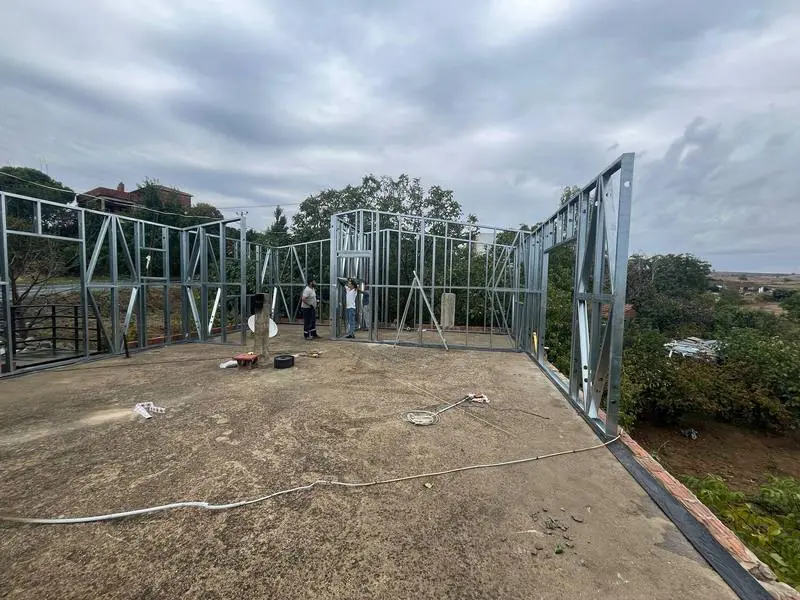
A light steel house is not weak because it is light — it is strong because it is light. Seismic force is proportional to the weight of the building; wind, meanwhile, tries to lift a light structure. The solution in both cases is the same: correctly calculated profiles, bracing, and solid anchoring into the foundation. With those three in place, light steel both flexes and stands firm.
1. Wind: The Most Pronounced Load in Thrace
Thrace is one of the windiest regions of Turkey — it is no accident that wind farms are concentrated here. The poyraz from the northeast and the karayelfrom the northwest reach high speeds, especially on open land and along the coast (Tekirdağ, Şarköy, the Gulf of Saros). That is why wind load cannot be ignored in building design in Thrace.
Wind acts on a building in two ways:
| Wind effect | What it does | The light steel solution |
|---|---|---|
| Horizontal push | Tries to push the wall over sideways | Diagonal bracing + closer stud centres |
| Uplift | Sucks the roof and the house upwards | A continuous anchor chain from roof to wall to foundation |
| Suction / pressure | Strips the facade and roof covering | Calculated screw spacing + cladding fixings |
The critical point is the uplift force. A light structure is more prone than concrete to being shifted in a strong wind — but that problem is solved with hold-down anchors that lock the house together from the roof down to the foundation. A properly anchored light steel house stands safely in the Thrace wind; on every project we calculate the wind load separately from the data for the plot.
A light steel frame, with every member screwed to the next, forms a monolithic cage that works as a single piece . When wind loads one point, the load is distributed through the whole system. And because the profiles and anchors are made to millimetre calculations, no weak link is left.
2. Snow: Taken Seriously in Northern Thrace
Winters in Thrace are cold; snow load is significant particularly around the Yıldız (Istranca) Mountains — Kırklareli, Demirköy, northern Edirne. Snow puts a constant, heavy load on the roof; a badly designed roof collapses under it.
With light steel, snow load is managed by two things:
| Measure | Benefit |
|---|---|
| Truss section and spacing by region | Carries the snow load as calculated |
| A suitable roof pitch | Snow runs off instead of building up, reducing the load |
| Snow drift control | Accumulation at chimneys and ridges is taken into account |
A light steel truss system is sized for the snow load in the factory. So a house in Kırklareli and one on a milder coastal plot are not made with the same roof — each is calculated for its own snow load.
3. Earthquakes: Southern Thrace Is Active
"There are no earthquakes in Thrace" is a mistaken belief. Southern Thrace is seismically active because of the northern branch of the North Anatolian Fault (the Ganos / Saros segment) running through the Sea of Marmara. Historically, the 1912 Mürefte-Şarköy earthquake (around 7.4) was a major event produced by this fault and caused heavy damage in the region. Seismic design is therefore essential for Tekirdağ and southern Thrace.
And this is where light steel is at its strongest. Seismic force rests on one simple fact:
Seismic force is directly proportional to the weight of the building. A concrete house is many times heavier than a light steel one of the same size — and therefore attracts many times more force in an earthquake. Light steel attracts less force because it is light, and meets that force safely through ductile behaviour that flexes and absorbs energy.
All our light steel projects are calculated to TBDY 2018 (the Turkish Building Earthquake Code) and the standards applicable to light steel. Instead of failing and collapsing during an earthquake, the structure flexes in a controlled way and stays standing.
Three Loads at Once: Why Light Steel for Thrace?
| Thrace condition | Risk | Light steel advantage |
|---|---|---|
| Strong wind (poyraz / karayel) | Horizontal push + uplift | Bracing + a complete anchor chain |
| Snow load (northern Thrace) | Roof load | Region-specific trusses + the right pitch |
| Earthquakes (Marmara / Ganos) | Collapse | Light weight = less force + ductility |
| Damp, windy climate | Corrosion | Galvanised steel + correct facade detailing |
The demanding climate of Thrace (wind + snow + earthquakes) maps exactly onto the three areas where light steel is strongest. Because the data for every plot differs there is no single magic design — what matters is that your house is calculated for the loads on your own plot.
Which Cities Do We Serve?
MefSteel Tekirdağ is our base; from there we serve the whole of Thrace and the European side of Istanbul: Tekirdağ (Süleymanpaşa, Çorlu, Çerkezköy, Malkara, Şarköy, Marmara Ereğlisi), Edirne (centre, Keşan, Uzunköprü), Kırklareli (centre, Lüleburgaz, Babaeski) and the surrounding districts. Every project is calculated separately for the wind, snow and seismic data of its area.
Frequently Asked Questions
Will the roof blow off in the Thrace wind?
Not on a properly anchored light steel roof. The roof is locked to the wall and the wall to the foundation with hold-down anchors, so the uplift force of the wind is distributed through the whole structure. Roofs that blow off are generally ones where the anchoring was inadequate or never calculated.
On the coast (Şarköy, Saros), does salty, damp air rust the steel?
Light steel profiles are galvanised (zinc coated), which provides strong protection against corrosion. In addition, correct facade detailing and a water and wind barrier keep the steel away from moisture. On coastal plots the galvanising grade and the facade detail are chosen accordingly.
Does a light steel house remain usable after an earthquake?
Thanks to its ductility, light steel is designed to absorb energy in an earthquake and stay standing. Because it is light, the force it attracts is low, which reduces the risk of structural damage and in most cases keeps the building usable.
Let us design a light steel house tailored to the wind, snow and seismic data of your plot. 0553 543 02 12or share your project through the contact form — we serve Tekirdağ, Edirne, Kırklareli and the whole of Thrace.